Floating Works
Curator: Nara Huang
Artist: Kang Shixin
Organizer: HOW Art Museum (Wenzhou)
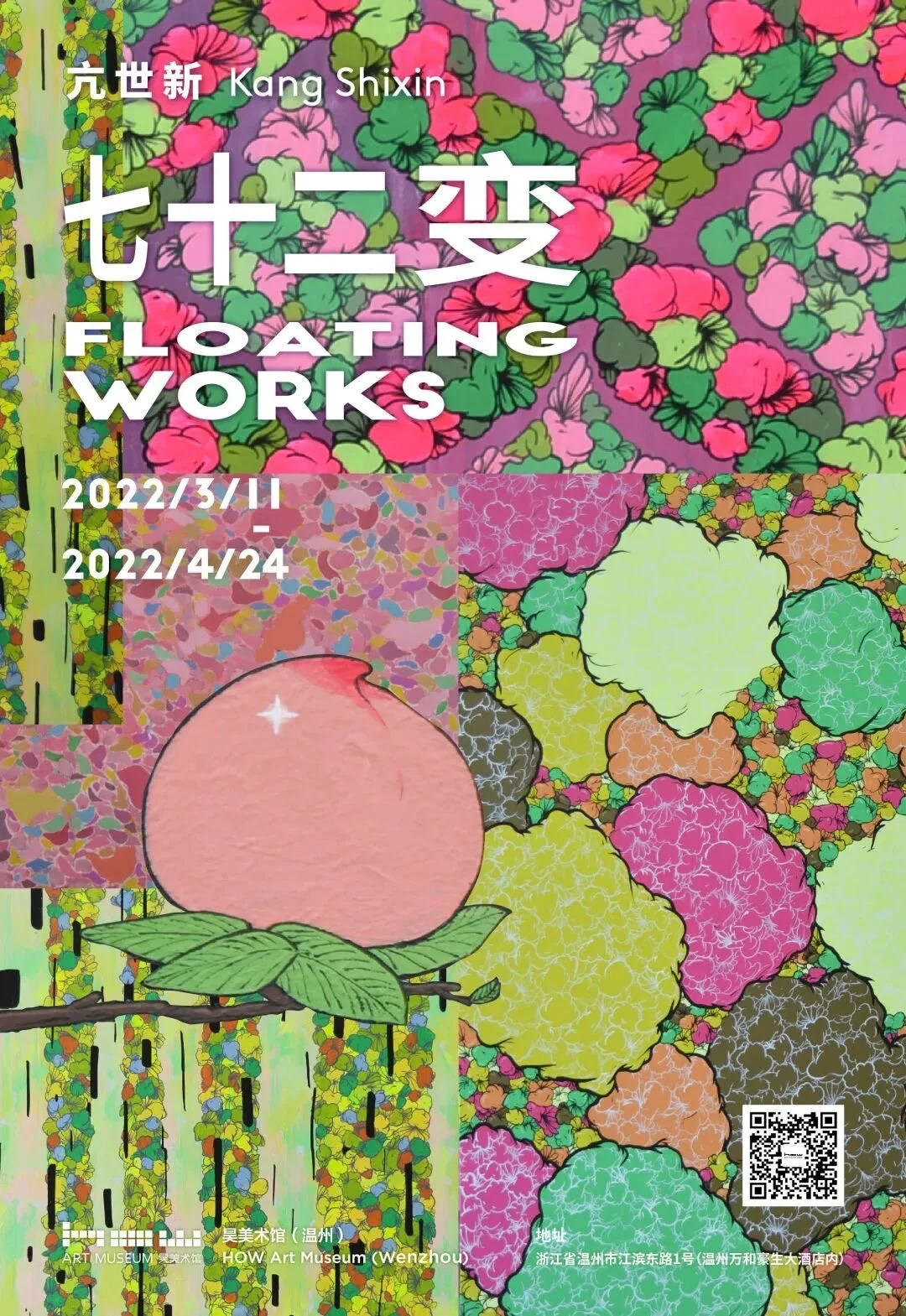
Poster designed by Xulei Li
The works of artist Kang Shixin are imbued with dramatic visual language, emotional expression, and thematic depth. Much like Sun Wukong, who could transform into anything by plucking a single hair, Kang Shixin's artistic creations undergo myriad variations, unrestrained and boundless, echoing the spirit of "Journey to the West." In Wu Cheng'en's narrative, Sun Wukong is portrayed as unpredictable and carefree, never tethered by explanations for his transformations—akin to an artist's approach to their artworks, ever-changing and infinite. In essence, when Kang Shixin faces his canvas, he encounters Wu Cheng'en, and what he paints embodies the freedom, carefreeness, and heroic spirit of Sun Wukong. The exhibition unfurls from a single peach in the artwork "Wukong's Seventy-Two Transformations," showcasing how the artist adeptly captures the "seventy-two changes" experienced in the ebb and flow of life.
Kang Shixin's oeuvre has evolved from early narrative and figurative styles to vividly expressing the undulating waves of his inner world through strong personal colors and abstract imagery. Changes extend beyond stylistic shifts, incorporating transformations in representational images within the artist's repertoire. From eyeless figures in "Chess Piece Cannon Fodder Chronicles" to the flowing-haired river demon emerging from a sea of flowers in "Bao Ta Zhen River Demon," and the "us" transformed into "An Electronic Screen" in the internet age. As time passes, the characters in the artworks seem to be veiled in a hazy palette, inviting continual reinterpretation. Kang Shixin's works undergo seventy-two changes in the eyes of the viewers, like a demon- revealing mirror reflecting myriad faces, sparking boundless imagination, allowing a story frozen in a moment to infinitely unfold.
Simultaneously, the recurring floating and elusive themes and elements in Kang Shixin's seventy-two transformations are inherently changeable. His works possess dynamic fluidity. For example, the tumultuous and struggling masses in the "Thirty-Six Strategies" series depict the ever-changing nature of war. In Kang Shixin's more abstract recent works, dancing flowers and the incessant flow of rivers symbolize new insights into change. The artist captures fleeting moments and current feelings and thoughts on the canvas. Art does not necessarily need to rely on realism for depiction. Just like Sun Wukong, we can soar through the sky, dive into the depths of the sea, traverse mountains and hills, and immerse ourselves in a sea of flowers within Kang Shixin's works. It can travel under the sun and moon without casting shadows, freely crossing the boundaries of reality.
The exhibition “Floating Works” is a journey full of drama and change, expressing the artist's rich mindset and creative diversity in the ebb and flow of life. Through the portrayal of freedom, carefreeness, and heroism, the exhibition presents the artist's exploration of the diverse facets of the world.
Curator: Nara Huang
![Portfolio-XIN YUE (NARA) HUANG[88]_Page_20.jpg](https://images.squarespace-cdn.com/content/v1/695e00ef6efe8a354ee8be79/8cba2a4e-37fd-4aaa-9545-ebadeabafe78/Portfolio-XIN+YUE+%28NARA%29+HUANG%5B88%5D_Page_20.jpg)
![Portfolio-XIN YUE (NARA) HUANG[88]_Page_21.jpg](https://images.squarespace-cdn.com/content/v1/695e00ef6efe8a354ee8be79/19cbb601-6d1c-49d1-a67c-f97be4dd75ae/Portfolio-XIN+YUE+%28NARA%29+HUANG%5B88%5D_Page_21.jpg)
![Portfolio-XIN YUE (NARA) HUANG[88]_Page_22.jpg](https://images.squarespace-cdn.com/content/v1/695e00ef6efe8a354ee8be79/486627c4-4437-4383-8e2b-3478c98eae1b/Portfolio-XIN+YUE+%28NARA%29+HUANG%5B88%5D_Page_22.jpg)
![Portfolio-XIN YUE (NARA) HUANG[88]_Page_18.jpg](https://images.squarespace-cdn.com/content/v1/695e00ef6efe8a354ee8be79/ea658b52-5565-46e2-9f15-d7cdcffe8c70/Portfolio-XIN+YUE+%28NARA%29+HUANG%5B88%5D_Page_18.jpg)
![Portfolio-XIN YUE (NARA) HUANG[88]_Page_19.jpg](https://images.squarespace-cdn.com/content/v1/695e00ef6efe8a354ee8be79/def5b748-0abc-49ad-a62e-00fca8bd4c89/Portfolio-XIN+YUE+%28NARA%29+HUANG%5B88%5D_Page_19.jpg)
亢世新:七十二变
艺术家亢世新的作品在视觉语言,情感 表达和⻛格主题上极具戏剧性。正如孙悟空一般,拔掉一根毫毛就可以变成他 所想的任何事物。在《⻄游记》中,吴 承恩令孙悟空变化莫测,亦随意潇洒, 从来无需交代理由,恰如艺术家之于画 作,万般变化,无穷无尽。换言之,亢 世新面对他的一方画卷,即是吴承恩, 他的画笔下谱写的即是孙悟空的自由、 潇洒与豪情。本次展览由作品《悟空的 七十二变》中的一颗蟠桃展开,展示艺术家如何在艺术世界中灵活自如地拿捏他在人间浮沉中所体会到的“七十二变”。
亢世新的作品从早期叙事性的具象⻛格逐渐转变为以强烈的个人色彩和图像抽象地表现他内心世界的波澜起伏,既有⻛格上的变化,也包含艺术家作品中具象形象的转变。从《借尸还魂之棋子炮灰记》中没有眼睛的人,到《宝塔镇河妖》中从一片花海中翻涌而出的⻓发河妖,再到在互联网时代变成《一块电子屏》的“我们”。随着时光流逝,作品中的人物也仿佛蒙上了朦胧的色彩,人们不断用新的方法去诠释曾经的事物,促成了亢世新的作品在观者眼中的七十二 变。它们像照妖镜一般呈现在观众面 前,千人千面,激发观众无尽的想象, 让一个定格在瞬间的故事得以无限延伸。
同时,亢世新七十二变的作品中时常出 现的漂浮不定的题材和元素,本质上就 是多变的。他的作品具有动态的流动性。例如“三十六计”系列变化无常的战 争中的乌合之众是动荡且挣扎的。而在亢世新近年愈加抽象的作品中,随⻛飘 舞的花朵和川流不息的河海则是新的关于变化的体悟。艺术家在画布上描绘当 下转瞬即逝的瞬间和当下的感受和思 考。艺术并非需要依靠现实主义来描 绘。正如孙悟空,我们可以在亢世新的作品中遨游天际,潜入海底,翻山越 岭,置身花海。它可以在日月下旅行而不留阴影,也可以自由地穿越现实的边界。
Nara Huang